
Aesop’s Fables adapted for Level 2 English learners with simple grammar and vocabulary.
Contents:
The Wolf and the Kid
There was once a little goat called Kid. His horns were growing fast and so he thought that he was an adult Goat and that he was able to take care of himself. One evening when the flock started walking home from the fields, his mother called at him as usual. But Kid paid no attention to her and kept eating the juicy grass. A little later when he lifted his head, the flock of goats was gone.
Now he was all alone and the sun was sinking. Long shadows started growing all over the ground. A cold little wind came with the shadows and it was making scary noises in the grass. The Kid shook as he thought about a terrible Wolf. Then he started to run wildly over the field, calling for his mother. But not far away, near a group of trees, there was the terrible Wolf!
When Kid saw the Wolf, he knew there was little hope for him.
“Please, Mr. Wolf,” he said shaking, “I know that you are going to eat me. But first, please, could you sing me a song? Because I want to dance and be happy as long as I can.”
The Wolf liked the idea of a little music before eating, so he started singing a happy song. While he was singing, Kid jumped up and began to run to the flock and his mother.
Meanwhile, the flock was moving slowly towards home. In the quiet evening air, the Wolf’s singing could be heard very far. The Shepherd Dogs raised their ears and listened carefully. They recognized the song which the Wolf sings before every big meal. They immediately started running back to the field to fight the Wolf. The Wolf’s song ended suddenly, and as he was running away, with the Dogs at his heels, he called himself a fool. He was angry with himself that he sang a song to the little Kid and didn’t eat him instead.
Lesson: Do not let anything to turn you from your purpose.

The Tortoise And the Ducks
The Tortoise, you know, carries his house on his back. No matter how hard he tries, he cannot leave home. They say that Jupiter punished him, because he was so lazy that he stayed at home all the time. One day Jupiter invited him to his wedding, but he refused to come and stayed at home instead. And so, Jupiter put his home on his back forever.
After many years, Tortoise began to be sorry that he didn’t go to that wedding, when Jupiter invited him. When he saw how happily the birds flew about and how the Hare and the Squirrel and all the other animals ran quickly by him, because they always wanted to see everything what they could see, the Tortoise felt very sad and unhappy. He wanted to see the world too, but he couldn’t. He had to stay at home because he had his house on his back and his little short legs could only very slowly move his house along.
One day he met a pair of Ducks and told them all about his trouble.
“We can help you to see the world,” said the Ducks. “Just take this stick to your mouth and hold it with your teeth. We will take the stick and we will carry you far up in the air where you can see the whole countryside. But remember! You must keep quiet or you will be sorry!”
The Tortoise was now very glad. He held the stick strongly with his teeth, and each of the two Ducks took one end of the stick too. Then they flew up toward the clouds.
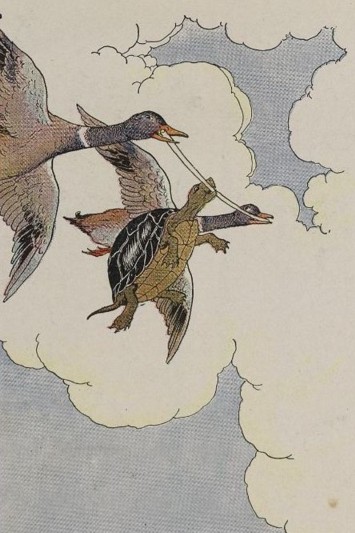
Just as they were flying high in the sky, a Crow flew by. He was very surprised to see the Tortoise so high up in the air and so he shouted:
“This must surely be the King of Tortoises!”
“But certainly…” began the Tortoise.
But as he opened his mouth to say these foolish words he couldn’t hold the stick anymore, and he fell down to the ground on a rock, where he broke into many pieces.
Lesson: Foolish curiosity and vanity often lead to bad luck.
The Young Crab And His Mother
“Why in the world do you walk sideways like that?” said a Mother Crab to her son. “You should always walk straight forward with your toes turned to the front.”
“Please, show me how to walk, mother dear,” answered the little Crab obediently, “I want to learn it.”

So the old Mother Crab tried and tried to walk straight forward. But she couldn’t. She could walk sideways only, like her son. And when she wanted to turn her toes to the front she tripped and fell on her nose.
Lesson: Do not tell others how to act if you cannot set a good example.
The Frogs And The Ox
An Ox came down to a river bank with a lot of high grass because he wanted to drink. As he ran heavily into the water, he stepped on a young Frog and killed him. The old Frog soon missed the little one and wanted to know where he was. And so she asked his brothers and sisters what happened to him.
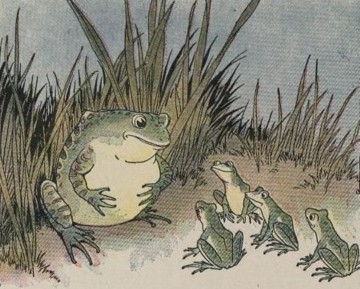
“A great big monster,” said one of them, “stepped on our little brother with one of his huge feet!”
“Big, you say!” said the old Frog and took some air in her lungs to be bigger. “Was he as big as this?”
“Oh, much bigger!” they shouted.
And so the Frog took more air in her lungs.
“He certainly was not bigger than this,” she said. But the little Frogs all shouted that the monster was much, much bigger and the old Frog kept taking more and more air in her lungs, until suddenly, she burst.
Lesson: Do not try to do the impossible.
The Dog, The Cock, And The Fox
A Dog and a Cock, who were the best of friends, wanted to see something of the world very much. So they decided to leave the farmyard and to go out to the world along the road that led to the woods. The two friends travelled along in a very good mood and without meeting anyone. Nothing exciting happened on that day either.
In the evening, as the night getting near, the Cock started looking for a place to sleep. He found a hollow tree nearby and he thought it would be very nice for a night’s sleep. The Dog could sleep inside and the Cock would fly up and sleep on one of the branches. The Dog agreed to spend the night there and they both slept very comfortably.
With the first light of the morning the Cock woke up. For the moment he forgot where he was. He thought he was still in the farmyard where it was his duty to wake everybody up when the sun comes up. And so, he stood on his tiptoes, he waved with his wings and shouted loudly for everyone to know that it was the morning already. But he didn’t wake up the farmer because he was in the wood. He woke up a Fox instead, who was not far away from him. The Fox immediately imagined that he would have a very delicious breakfast. He quickly ran to the tree where the Cock was sitting on the branch, and he said very politely:
“Welcome, dear sir, to our woods! I cannot tell you how glad I am to see you here. I am quite sure that we shall become very close friends.”

“I am very pleased to hear such words, kind sir,” replied the Cock slyly. “Would you please go around to the door of my house at the foot of the tree? My servant will open the door and let you in.”
The hungry Fox didn’t suspect anything, and so he went around the tree as he was told. Suddenly, the Dog ran out of the tree and caught him.
Lesson: Those who try to deceive may expect the same.
Putting a Bell On The Cat
One day, the Mice called a meeting. They wanted to make a plan about how to free themselves of their big enemy, the Cat. At least they wanted to find some way how to know when the Cat was coming. That way they would have enough time to run away. And really, something had to be done, because they lived in such constant fear of her claws that they hardly went out of their homes by night or day.
Many plans were discussed, but none of them was good enough to solve their problem. At last a very young Mouse got up and said:
“I have a plan that seems very simple, but I am certain that it will be successful. All we have to do is to hang a bell around the Cat’s neck. When we hear the bell ringing we will know immediately that our enemy is coming.”
All the Mice were now happy and very much surprised that they didn’t think of such a plan before. But in the middle of shouting, jumping and celebrating their good luck, an old Mouse stood up from her chair and said:

“I would like to say that the plan of the young Mouse is very good. But let me ask you this one question: Who will hang the bell around the Cat’s neck?”
Lesson: It is one thing to say that something should be done, but quite a different thing to do it.
The Eagle And The Jackdaw
A huge Eagle with powerful wings suddenly flew down from the sky and caught a lamb in her talons. Then the Eagle flew with the lamb up again and took it to her nest. A Jackdaw saw what happened, and his silly head was filled with the idea that he was big and strong enough to do the same thing as the Eagle did. And so he waved with his wings strongly, his feathers rustled in the air, and he came down quickly on the back of a large Ram. But when he tried to fly up with the Ram, he found out that he could not lift him because he was too heavy. But he couldn’t just fly away either because his claws were caught in the wool on the Ram’s back. He was so small and so weak that while he was trying to carry the Ram away, the Ram hardly noticed he was there.

The Shepherd saw the Jackdaw waving his wings and he immediately guessed what happened. He quickly ran up to the Ram, caught the bird and clipped its wings. That evening he gave the Jackdaw to his children as a present.
“What a funny bird this is!” they said and laughed, “what do you call it, father?”
“That is a Jackdaw, my children. But if you asked him, he would tell you that he is an Eagle.”
Lesson: Do not let your vanity make you overestimate your powers.
The Boy And The Hazelnuts
A little Boy was given permission to put his hand into a big bottle with a narrow neck to take some hazelnuts. But when he put his hand inside, he took so many hazelnuts in his hand that his fist was bigger than the neck of the bottle. And so, he could not take his hand out again. Now he stood there and refused to give up a single hazelnut. At the same time, he couldn’t get them out all at once. He was upset and disappointed and began to cry.
“My boy,” said his mother, “if you are satisfied with half of the nuts which you are holding in your hand, you will easily get your hand out. Then perhaps you may have some more hazelnuts some other time.”
Lesson: Do not try to do too much at once.
Glossary:
constant /ˈkɒnstənt/ – (neustály) – happening all the time or repeatedly
claw /klɔː/ – (pazúr) – one of the sharp curved nails on the end of an animal’s or a bird’s foot
clip /klɪp/ – (pristrihnúť) – to cut something with scissors or shears, in order to make it shorter or neater
curiosity /ˌkjʊəriˈɒsəti/ – (zvedavosť) – a strong desire to know about something
deceive /dɪˈsiːv/ – (oklamať, podviesť) – to make somebody believe something that is not true
kid /kɪd/ – (kozľa) – a young goat
flock /flɒk/ – (stádo) – a group of sheep, goats or birds of the same type
foolish /ˈfuːlɪʃ/ – (hlúpe, bláznivé) – not showing good sense or judgement
glad /ɡlæd/ = happy, satisfied
jackdaw /ˈdʒækdɔː/ – (kavka) – a black and grey bird of the crow family
heel /hiːl/ – (päta) – the back part of the foot below the ankle
monster /ˈmɒnstə(r)/ – (príšera, obluda) – (in stories) an imaginary creature that is very large, ugly and frightening
obediently /əˈbiːdiəntli/ – (poslušne) – in a way that obeys what you are told to do
overestimate /ˌəʊvərˈestɪmeɪt/ – (preceniť) – to estimate something to be larger, better, more important, etc. than it really is
punish /ˈpʌnɪʃ/ – (potrestať) – to make somebody suffer because they have broken the law or done something wrong
purpose /ˈpɜːpəs/ – (účel) – goal; that, which something is supposed to achieve
rustle /ˈrʌsl/ – (šuchotať) – to make a sound like paper, leaves, etc. moving or rubbing together
sideways /ˈsaɪdweɪz/ – (bokom; do strany) – to, towards or from the side
slyly /ˈslaɪli/ – (prefíkane) in a secret or dishonest way, often intending to trick people
tiptoes /ˈtɪptəʊ/ – (na špičkách) – standing or walking on the front part of your foot, with your heels off the ground, in order to make yourself taller or to move very quietly
trip /trɪp/ – (podknúť sa) – to catch your foot on something and fall or almost fall
vanity /ˈvænəti/ – (márnivosť) – the fact of being too proud of your own appearance, abilities or achievements
English Reading, Level 2 – Sparrow’s English Reader (Adapted for Level 2 from the Original: The Aesop for Children, 1919, @ Rand McNally & Company)
 Sparrow's English Reader